Understanding the condition
PANDAS & PANS: when an infection changes a child
If your child changed almost overnight — new obsessions, tics, rage, refusing food, wetting the bed again, handwriting falling apart — you are not imagining it, and there is a name for it.
What is happening
PANDAS — Pediatric Autoimmune Neuropsychiatric Disorders Associated with Streptococcal infections — and PANS — Pediatric Acute-onset Neuropsychiatric Syndrome — describe a sudden, dramatic onset of neuropsychiatric symptoms in a child, triggered by an infection or another immune insult.
In the widely used model, an infection (most classically Group A Streptococcus) provokes an immune response that cross-reacts with the child's own brain — a process related to autoimmune encephalitis — producing inflammation in the regions that govern behavior, movement, and emotion.
The hallmark is the abruptness. A previously healthy child can change almost overnight. Parents frequently describe knowing the exact week it started.
PANDAS vs. PANS — the short version
PANDAS is the strep-specific subtype: associated with a streptococcal infection, prepubertal onset, and a relapsing-remitting course tied to infection.
PANS is the broader umbrella: the same acute-onset picture triggered by strep or other infections — Mycoplasma, influenza, Lyme, other viral illnesses — or by non-infectious immune triggers.
All PANDAS is PANS. Not all PANS is PANDAS.
What it looks like
The core feature is the dramatic onset of obsessive-compulsive behavior and/or severe food restriction, accompanied by some combination of:
- Tics — sudden motor or vocal tics that weren't there before
- Extreme anxiety and separation fears — a child who suddenly cannot be alone in a room
- Emotional lability and rage episodes — out of character, often prolonged, frightening to everyone including the child
- Developmental regression — baby talk, bedwetting, loss of skills a child had mastered
- Deteriorating handwriting and school performance — often one of the first things a teacher notices (see our guides for schools)
- Sleep disturbance, sensory sensitivities, and motor abnormalities
If your child is talking about wanting to die, or is in immediate danger, call or text 988 (Suicide & Crisis Lifeline), call 911, or go to the nearest emergency department. Severe cases of these conditions can include suicidality, and it is a medical emergency — not a behavior problem.
How common is this?
Reliable prevalence figures are difficult, because these conditions are under-recognized, frequently misdiagnosed, and lack a single confirmatory lab test. Estimates vary widely by method. We plan conservatively while recognizing the scale of the need.
| Geography | Children under 18 | Est. affected* | New onsets / yr** |
|---|---|---|---|
| United States | ~73,000,000 | ~365,000 | ~6,200 |
| California | ~8,700,000 | ~43,500 | ~740 |
| Los Angeles County | ~1,861,000 | ~9,300 | ~158 |
| L.A. + Ventura + Orange | ~2,850,000 | ~14,250 | ~240 |
*Prevalence applied at a commonly cited 1-in-200 basis. **Applies a conservative published incidence estimate of ~8.5 per 100,000 per year to the ages 3–12 band. Both columns are shown to make the plausible range visible rather than to argue for a single number. Population figures from U.S. Census and L.A. County estimates.
Onset skews young
About 69% of cases begin between ages 4 and 9, with a mean onset age around 6 to 7 years.
Strep is common, not universal
Roughly 81% of cases report a strep trigger; about 19% follow other infections — which is why care has to cover the full PANS spectrum.
Autoimmunity runs in families
About 70% of families report autoimmune illness in close relatives, making family history a meaningful part of intake.
The diagnostic odyssey
The lived experience of affected families is defined by delay, denial, and fragmentation.
- Delayed and missed diagnosis. Symptoms look psychiatric, so children are routed to mental-health care first and the underlying infectious or immune driver is missed. Families routinely see many providers over months to years before a correct diagnosis — losing the early-treatment window when outcomes are best.
- Fragmented care. Treatment requires pediatrics, immunology, infectious disease, psychiatry, and behavioral therapy working together. In practice these specialists rarely coordinate, and no one clinician owns the child's care.
- Insurance denials. Because no therapy is FDA-approved specifically for PANS/PANDAS, treatments — especially IVIG — have historically been denied as experimental, forcing families to pay out of pocket, deplete savings, or forgo care.
- Geographic deserts. True multidisciplinary programs are scarce and concentrated at a few academic centers. Families travel across states for care.
Why this is urgent
PANDAS and PANS are treatable — and treatment is time-sensitive. Early, appropriate intervention (treating the infection, calming the immune response, supporting the child behaviorally) can return many children to full function. Every month of delay risks entrenched symptoms, lost schooling, family financial ruin, and in severe cases suicidality and complete loss of independence. The gap between what medicine can do and what families can actually access is the gap we exist to close.
For schools & school nurses
Teachers, aides and school nurses are often the first adults to notice a student's sudden change. These free, printable guides help school teams recognize the signs and point families to the right next steps.
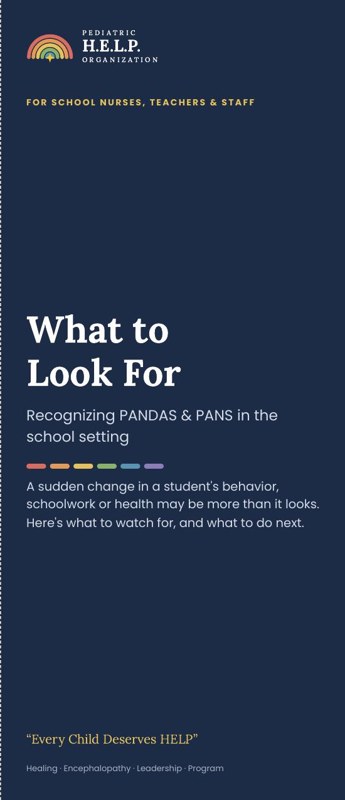
Guide 1 · For school staff
What to Look For
Covers the sudden-onset pattern and the signs to watch for in the classroom and the health office. It also includes a five-step plan for when you notice a change, plus classroom supports.
Download PDF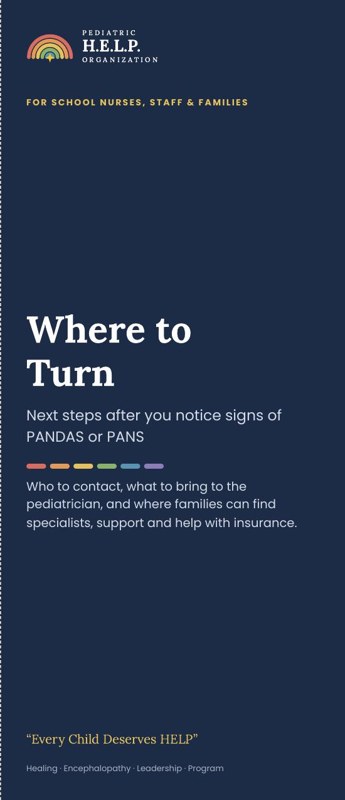
Guide 2 · For nurses & families
Where to Turn
Explains the path from school to pediatrician to specialist, and what to bring and ask. It lists national nonprofits, California insurance coverage under AB 2105, and integrative practitioners in Southern California.
Download PDFPrint double-sided on letter paper, flipping on the short edge, then fold in thirds. Want a training for your school or district? Request one.
Common questions
Can you see my child now?
Not yet. Our clinic is in development and we are not currently providing medical care, diagnosis, or treatment. Join our family list and we will notify you as soon as we open. In the meantime, bring what you've learned here to your pediatrician and ask specifically about a post-infectious neuroimmune cause.
What should I ask my pediatrician?
Ask whether an acute-onset neuropsychiatric presentation could have an infectious or immune trigger, whether strep titers and a broader infectious workup are appropriate, and whether the 2015 consensus criteria and the AAP's 2025 clinical report on PANS apply to your child's presentation. Bring a written timeline of when symptoms started — the abruptness is diagnostically meaningful.
Is this a real diagnosis?
Yes. PANDAS was first described by NIH researcher Dr. Susan Swedo, consensus diagnostic criteria were published in 2015 with updated guidance since, and the American Academy of Pediatrics issued a clinical report on PANS in 2025. It remains an area of active research and clinical debate, which is part of why coordinated, evidence-following care matters so much.
Does insurance cover treatment in California?
As of January 1, 2025, AB 2105 requires state-regulated California health plans to cover prophylaxis, diagnosis, and treatment of PANDAS and PANS, including immunomodulatory therapy such as IVIG, and prohibits denials based on prior diagnostic labels. Self-funded employer plans governed by ERISA are not bound by the state mandate.
Is IVIG always the treatment?
No. Published estimates suggest roughly 10–15% of children with PANS/PANDAS are candidates for IVIG. The general framework is three-pronged: treat the source infection, calm the immune and inflammatory response, and treat symptoms behaviorally and psychiatrically. What's right depends entirely on the individual child.
Sources
Everything on this page is drawn from public clinical and advocacy sources. We'd rather show our work.
- PANDAS Network — Statistics (prevalence, OCD/tics, onset ages)
- Frontiers in Pediatrics (2023) — Incidence of PANDAS/PANS in three primary-care populations
- American Academy of Pediatrics (2025) — PANS clinical report
- Stanford Medicine Children's Health — PANS/PANDAS multidisciplinary program
- Massachusetts General Hospital — Pediatric Neuropsychiatry & Immunology Program
- ASPIRE — California PANS/PANDAS updates (AB 2105)
- California AB 2105 — bill text